Author: Daniel Schmale

  • Spare Parts

    Spare Parts

    There are four categories of spare parts: cheap parts that are less needed, cheap part that are more needed, expensive parts that are less needed, and expensive parts that are more needed.
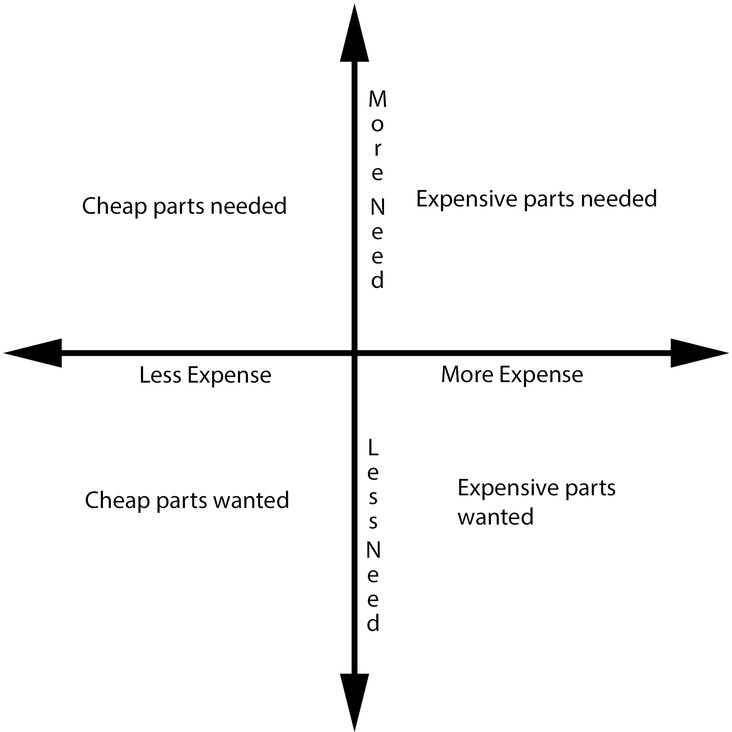
    Some parts tell the customer when they’re about to break – those parts fall into the less needed category as the customer has time to order the part. Let’s take your car for example. The car tells you the tires are wearing out, but you don’t need the tires that day. You can wait a week or two before replacing them, but if you continue to use them, they become a critical part. If your steering wheel breaks, you need to replace that immediately.

    Example one: A customer in Missouri called on a Friday that he needed a little tube about 1/8-inch thick that provided lubricant to two places in the machine. Something happened that this tube ripped off and he didn’t have any available. He didn’t have it in stock so now this part becomes a critical, needed part. He could have run the machine for a couple hours before the bearing wore out. He called Daniel and needed five feet of the tube. This tube is relatively cheap so Daniel had it in stock in Atlanta, GA and sent it via FedEx for next day delivery. The customer had the tube on Saturday and his maintenance workers installed it, getting the machine up and running.

    Example two: A customer in Ohio was worried about a planetary gear box, a large one, that could provide several thousand meters in application. He was worried about the gear box failing. He got in touch with Daniel over email and requested a replacement planetary gear box. The gear box cost well over $10,000 and that specific configuration was not in stock. Daniel got in touch with the manufacturer in Germany and discussed the manufacturing options. The manufacturer was capable of making that gear box within 24 hours. Daniel got into contact with the customer about his options. Meanwhile, the customer had done additional research and became aware that the gear box may not be the issue. The machine failure wouldn’t happen right away, so he chose to have the gear box made using the regular lead time and had it on stand-by.

    Example three: A customer in Kansas had a thunderstorm during the summer and lightning hit his building. Of course, he had an over voltage situation in his plant and a frequency converter broke down. That happened overnight, and the next morning, he found something was wrong. Schmale dialed in remotely to the machine to find the issue and saw right away that one frequency converter was malfunctioning. Daniel looked through his inventory in Atlanta, GA and found the spare part. He booked a ticket to Kansas City with the spare part in his bag and installed the part. The customer was up and running in 24 hours. He had an expensive part that was needed right away.
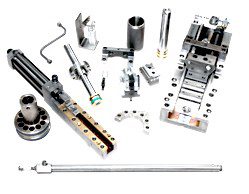
    Schmale wants to help in every and any case. To reach us, use the website or email, though email is preferable. We will use our own inventory in Atlanta, GA, Germany, and our suppliers to fix the issues at hand. We mail out the parts via FedEx within the US; mail out from Germany and we handle the customs; and provide emergency technicians to fly out to your location when needed.
  • An Ohio Company and Schmale’s X2000

    An Ohio Company and Schmale’s X2000

    An Ohio based company faced a severe problem with their production. It was complex with multiple machines, multiple steps, and lots of manpower needed. The production process was loud, messy, and inefficient. The company faced a decision: to continue their current production style or revolutionize and upgrade?

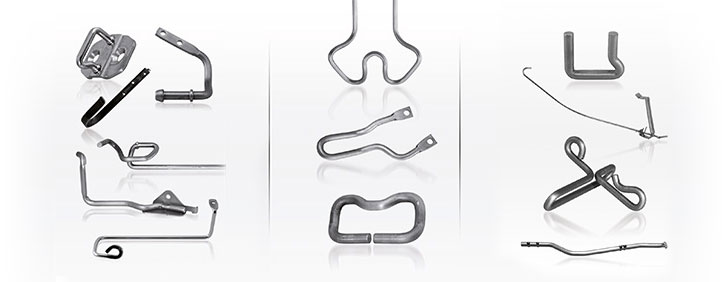
    They contacted Daniel Schmale in 2017 to see what Schmale Machinery could do for them. Daniel flew out from Atlanta, GA to their location in Ohio. There, he met with the team responsible for the production. He brought with him examples of parts that the X2000 series can produce. The team excitedly listened to what Daniel showed and told them. Of course, the experienced technicians knew their own process well. They knew what to look for. Most stunning to them were the speed and versatility of the Schmale machines. “That’s slick!” was one exclamation from a technician. The finance department and CEO saw a fast machine, almost no operators and clean production. The CEO looked over to his technicians and said “That’s engineer porn!” The CFO asked how much less the worker’s comp would be since the safety measures are far ahead of the ones in place.

    The technologies the X2000 can produce are almost endless. The machine can be used to have a very efficient mass production of complex parts. What does that mean? Many different materials can be used such as metal wire, strip metal (sheet metal), metal tube, plastic, and magazine different materials. One can use a broad spectrum of these materials from 1/16th to 1-inch wire. From these materials, there is a range of what one can use. A small X2000 with a short six-foot wall with some slides that can just bend wire is a simple thing. But add onto it to with additional walls, slides and presses to flatten, press, bend, punch and more. The utilization of the machine is very broad and you open the same machine up to a whole new spectrum of parts.

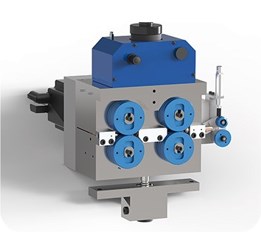
    Each station is mobile within the X2000. A station contains a press or slide that bend, flatten, or weld the parts. Presses and slides within the unit can be moved to produce an endless stream of different parts. The X2000 can handle up to fifteen different stations to create the most intricate parts.

    With Schmale machines, an additional part can be produced on the same machine. The slides and presses can be rearranged to make all kinds of parts. There is literally no end in sight. For example, a wire part and a strip metal part can be produced on either end and meet in the middle to be welded together.

    The X2000 is compatible with a wide range of items. It can be compatible with a company’s own tools. If a customer wants to use his tool set, then Schmale will make it happen. With some companies, they do not want to show their tool sets to anyone and they don’t have to. Schmale will make it compatible without seeing the tool sets, so the company does not need to share their proprietary information. Also, there are many third-party items that the customer may have. A decoiler, for example, can be kept by the customer and integrated into the X2000. The same is true with welding units and other units that can be integrated. It goes so far as Schmale does not buy the unit, the customer does and then the unit is integrated into the machine. Schmale machines are also compatible with Bihler machines, a German company that produces smaller wire bending machines.

    The company was astonished at all the X2000 could do and what it could offer. They thought it over and considered what needed to change within their company before they could agree. Daniel was there to answer all of their questions and concerns. The sale wasn’t made that day, but Daniel would be back again a few months later.

    The company had a long talk within their team about what to do. Their production was average and they needed a way to increase it. Schmale Machinery offered what they needed, and more, in a revolutionary way. They could downsize their machines to an all-in-one option. The production would be more efficient, they would have increased output, a higher quality product, increased versatility with the X2000 if they wanted to change parts produced, and the possibility of decreased cost per piece produced.

    In time, the Ohio company chose Schmale and invested in their own X2000 series machine. They avoided costly second production, time consuming production with multiple machines, and inefficient production. Schmale’s excellent customer service sent out a technician to assist the company with their production and training. The operation was simpler than they thought since the X2000 runs similar to a traditional mechanic machine, except with servo-electric drives. The training lasted one week and customer service was always on stand-by to assist, if needed.

    After a couple of months, the customer began work on his own tool sets for the Schmale machine. Before long, the technicians had a dozen tool sets migrated. A road building section was that Schmale provides 3D-data of their machines, so customers can start from there.

  • Servo-electric drives

    There are four types of drives used in wire bending machines: traditional motors, hydraulic, pneumatic, and servo-electric motors. Each has their advantages and disadvantages, but servo-electric drives have the highest advantages compared to the others. They are revolutionizing the production industry.

    Traditional motors only run on one speed. They are not very good at running the speed they are set on. For example, a 3000 RPM motor will actually run at about 2800 RPM. If more torque is needed, the speed decreases. It’s a tradeoff between torque and speed. Servo electric motors utilize a device called a frequency converter and they control the speed the motor is running within a few RPM and they control the torque. The frequency converter checks on the values a thousand times a second. They have extreme precision and provide that to the machines. The servo-electric motor, for example, can bend wire and precisely adjust to the command position.

    Hydraulic systems need a lot more energy, about ten times, compared to the servo-electric motors. The hydraulic systems are also not as precise and often require extensive work to make adjustments. Servo-electric motors are a simple touch on a touchscreen to make the adjustments. There are no hard stops or valves to adjust.

    There are only so many energy sources to run a machine. A machine can be driven by electricity, like the servo-electric motors, traditional motors like in a ceiling fan, hydraulic systems which are very popular in the US, or pneumatic actuators are driven from a large air compressor and air cylinders. Schmale Machinery uses pneumatics to a degree. The advantage to pneumatics is the price level. The disadvantages are they can only be turned on and off, they must be replaced regularly and the force level is small, like to hold a wire in place.

    Mechanic machines have the advantage of being very precise once they are adjusted. For example, a clock. Mechanic systems can be very precise and fast if done right, but they are not flexible, can be very loud, and difficult to adjust.

    Schmale Machinery started with mechanic machines in 1965 and it was a great fundament for the company. US companies have thousands of mechanic machines since that is what they grew up with! Schmale then went to a hybrid between hydraulic and mechanic only Schmale had. It took the best of both worlds. Schmale moved to servo-electric motors in the early 2000’s.

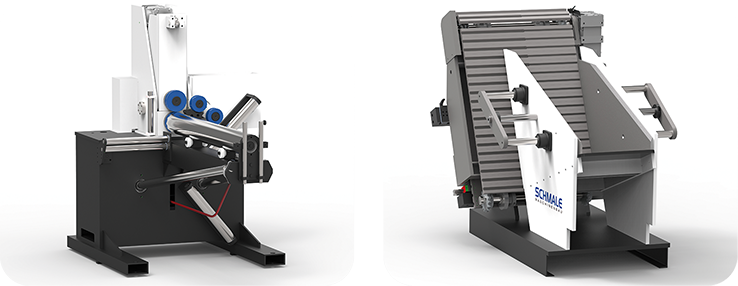
    Schmale Machinery uses servo-electric drives in all of their feeders, presses, thread formers, finger benders, decoilers, and buffer magazines. Their decoilers can work with coils of up to 5 tons, and wires with diameters that range up to 1”, and they are fabricated with a robust design that allows for a higher reliability.

    Their servo-electric feed-in rollers are units that help to automatically feed the metal wire into the fabrication cycle. With an easy and simple setting, and (almost always) the possibility of performing adjustments while running, they enable one to have a precise and smooth transition of the material from the coil to the fabrication process. Among other possibilities that the servo-electric feed-in rollers allow can include movement when the system is stationary, several strokes per cycle, feed-in length with no limitations, saving the feed-in length information and profiling of the material.

    Schmale’s buffer magazines are an important tool to control the timing of the material processing. They allow for a controlled delivery of specific materials such as cut sections. Another important characteristic is that they have very low energy consumption. However, it is important to know that the length of the material cannot be changed as easily.

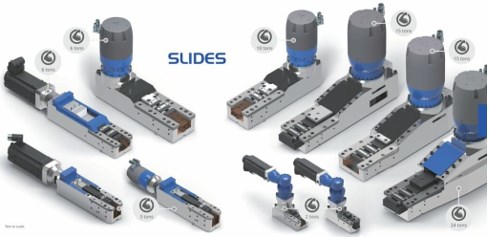
    Schmale can offer a wide variety of slides and presses in several styles, being the hydraulic driven slides and presses as the oldest and the servo-electric driven slides and presses as the newest and most innovative. The main difference between the hydraulic driven and the servo-electric ones is the basic principle of operation. While the hydraulic driven slides and presses use the hydraulic force principle to perform bending, punching or any other forming process needed, the servo-electric units operate by means of an electric motor that is attached to them with all the operation being computer and PLC controlled.

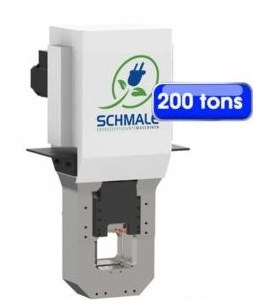
    While some slides found in the market can only reach up to 6 tons of operational force, Schmale’s slides can go to operational forces that are 4 times higher, with standard models of 2 tons, 6 tons, 10 tons, 15 tons and 24 tons. The servo electric driven presses can cover a wide range of operational forces, with standard models of 40 tons, 80 tons, 120 tons, 160 tons, 200 tons, 250 tons, 300 tons, and 700 tons. This is very helpful for those specific and special applications that can be found in the metal manufacturing industry.

    The transfer systems between the slides and presses is another great feature run by servo electric motors and pneumatic actuators. In seamless movements, parts are transferred between stations to have the next step in production completed. There is no need to stop production to transfer the parts to the next stage.

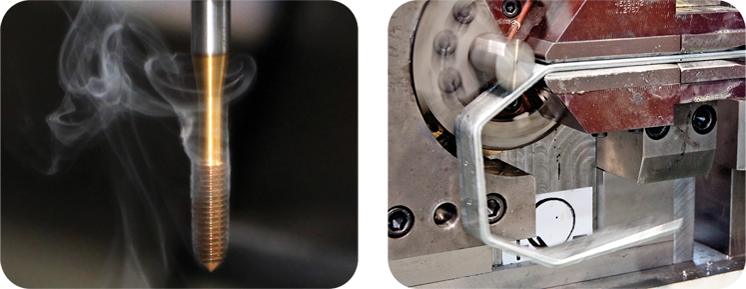
    Some applications require threaded sections, which is why a thread former may be essential in different fabrication cycles. These servo-electric units, which are called thread formers, are also fully automated with automatic positioning above the material, automatic change between different thread formers, and a typical thread forming process that can be completed in 1 second including tool changing.

    Another common forming process in metal parts manufacturing is bending. Their finger benders are also automated servo-electric units that allow to achieve the desired shape on metal wires and strips. They have the capability of bending wire from 2mm to 25mm (1″) of diameter and sheet metal.

    Schmale Machinery is renowned for their innovation and revolutionary machines. Call 678-365-1015, email daniel.schmale@schmale-machinery.com, or visit our website schmale-machinery.com to schedule an appointment at your company today!